p1 — Visual motion (optomotor + looming)
Goal: measure how the fly responds to wide-field motion (optomotor turning) and to looming stimuli (approaching objects that trigger avoidance/escape). Each trial also starts with a brief optogenetic pulse.
Files: use the revised p1_motion_v2_short.yaml (about 2.7 min) and p1_motion_v2_full.yaml (about 7.9 min). Fly-on-ball rig; open-loop visual stimulation. FicTrac is still recorded for behavior, but the fly does not steer the display in this protocol.
Open in Arena Studio
These links open the shared protocol from the private course repository in the Run view and force safe mode.
| Version | Link |
|---|---|
| Short | Open p1 short |
| Full | Open p1 full |
If the browser is not signed in to GitHub yet, Arena Studio will stay in safe mode and ask you to sign in before loading the protocol.
Pattern previews
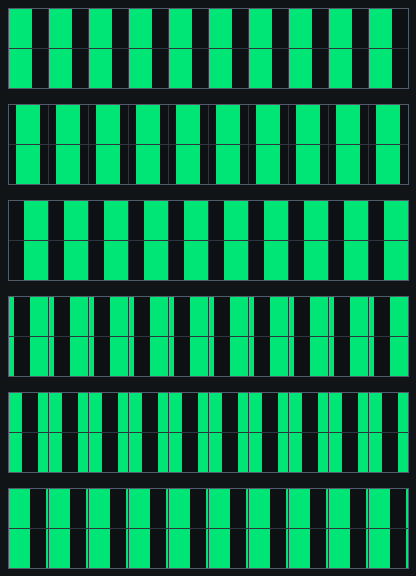
Optomotor gratings
| 36° spatial period | 72° spatial period |
|---|---|
 |  |
Looming and loom controls
| Expanding dark disc | Expanding annulus | Multi-dot control |
|---|---|---|
 |  |  |
The optogenetic prestim
Every visual trial begins with a 0.5 s LED pulse at 25% while the pattern is held on its first frame. The LED then turns off for the moving stimulus. So each trial is “brief light, then motion.”
What the fly sees
- Optomotor gratings — drifting gratings at 2 spatial periods and several speeds, in both directions (CW/CCW). A fly tends to turn with the motion. In v2, each spatial period includes a static (0 Hz) condition plus moving conditions paired at matched temporal frequencies.
- Looming — expanding dark stimuli that simulate an approaching object, at 3 classes × 5 positions × 2 speeds. These probe avoidance/escape-like behavior. The loom files include duplicated final frames so the image holds steady at maximum size instead of rolling over.
Looming stimulus logic
A looming stimulus is an expanding object on the visual panorama. To the fly, this can approximate an object approaching on a collision course. The main p1 loom is therefore a dark expanding disc, inspired by work on looming-responsive visual pathways such as LC6.
P1 also includes stimulus controls. The expanding annulus keeps an expanding edge but reduces the sustained dark area. The multi-dot control tests whether responses depend on one coherent object or can also be driven by local dark features distributed across the same region. These controls are deliberate: stimulus controls are treated as seriously as genetic controls, because they help separate “the fly detected an approaching object” from simpler explanations such as local darkening, edge motion, position, or final image state.
Trial counts (v2 full)
| Component | Design |
|---|---|
| Optomotor | 2 spatial periods × (1 static + 5 temporal frequencies × 2 directions) × 3 reps = 66 trials |
| Looming | 3 stimulus classes × 5 positions × 2 speeds × 3 reps = 90 trials |
Trials run in a fixed, paired order: opposite-direction optomotor trials and left/right looms are adjacent. A static gray background is shown between trials instead of blanking the arena.
What to watch
- Optomotor: does the fly turn in the direction of grating motion? Does the strength depend on speed / spatial period?
- Looming: does the fly react (turn away, freeze, or attempt escape) as the object expands? Does position matter?
Timing
Short version ≈ 2.7 min. Full version ≈ 7.9 min before setup/metadata overhead.
Run short first. If the fly is walking and the responses look interpretable, run the full version on the same fly. If both are usable, they can be pooled in analysis.
Analysis plots
Planned first-look plots:
- Optomotor turning traces with CW and CCW directions shown separately.
- Optomotor response matrices: rows = spatial period, columns = temporal frequency.
- Looming response matrices: rows = stimulus class, columns = loom speed, with left/front/right positions shown separately or facet-labeled.
- Average forward velocity from the start of the experiment, using a centered 0.5 s window.
References
- Morimoto MM, Nern A, Zhao A, Rogers EM, Wong AM, Isaacson MD, Bock DD, Rubin GM, Reiser MB (2020). Spatial readout of visual looming in the central brain of Drosophila. eLife 9:e57685. https://elifesciences.org/articles/57685
- Strother JA et al. (2017). The emergence of directional selectivity in the visual motion pathway of Drosophila. Neuron 94:168-182. https://doi.org/10.1016/j.neuron.2017.03.010
Genotype comparison: The primary P1 comparison is empty split versus T4/T5 > Kir. This stimulus set should evoke strong optomotor and looming responses in the control flies and reveal a prominent motion-response deficit when T4/T5 output is silenced. Other genotypes may also be informative and can be assigned after the first results are reviewed.
Updated 2026-07-10 01:47 ET. Source: protocols/shared/p1_motion_v2_*.yaml.