Micromanipulator
 → to GitHub project folder A fully 3D-printable three-axis linear micromanipulator optimized for simplicity and low cost. It serves two roles in the fly preparation workflow: at the tethering station to position a dispensing needle precisely on the fly’s thorax, and in the experimental setup to lower the tethered fly onto the spherical treadmill.
The design grew out of early experiments with the Open-Labware Micromanipulator. After printing that design and encountering assembly difficulties, we redesigned it from scratch in FreeCAD with simplified geometry, fewer parts, and no support material requirements.
Design
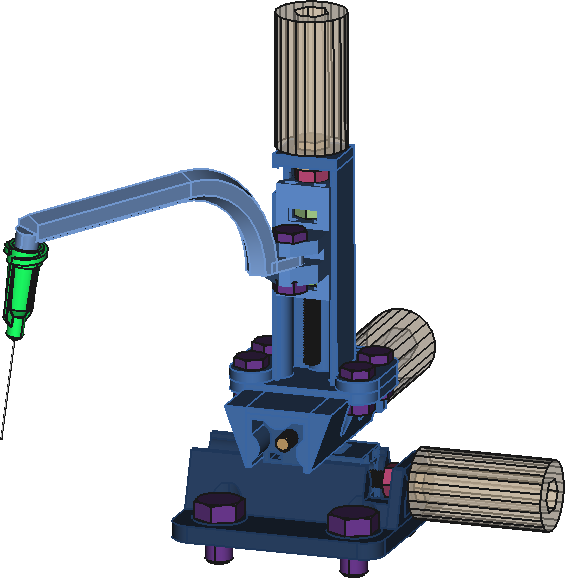 Three independent sliding axes are each implemented as a rail and a carriage. The carriages translate along their rails by hand via printed handles. The arm, which holds the dispensing needle or tether, is a separate part and can be swapped between different configurations without reprinting the full assembly.
All structural parts are available as FreeCAD source files (.FCStd) and print-ready STL files in the production/ folder.
Arm variants
Several arm geometries are provided for different use cases:
| File | Use case |
|---|---|
Arm_TetherStation.stl | Tethering station — reaches the fly in the sarcophagus |
Arm_Arena.stl | Experimental setup — positions tethered fly on the sphere |
Arm_tilted_Arena.stl | Arena variant with a tilted approach angle |
Arm_60.stl | 60° approach angle |
Arm_110mm-20degree.stl | 110 mm arm at +20°; longer reach with slight upward angle |
Arm_110mm--20degree.stl | 110 mm arm at −20°; longer reach with slight downward angle |
Inspiration and Alternatives
Design developed from experience with the Open-Labware Micromanipulator (BadenLab, Thingiverse thing:239105). The commercial 3-axis stage LD40-LM is an alternative with metric mount points, used in the Tethering Station v2.
Stand for the Tethering Station
→ to GitHub project folder A 3D-printed stand that positions the micromanipulator at the correct height and angle to reach the fly in the sarcophagus on the tethering station. The stand keeps the manipulator stable during the delicate procedure of placing a tether on the fly’s thorax.
A comparable stand for the experimental setup is described under Stands in the Walking Setup section. The two stands differ in height and geometry to suit the different working positions of the tethering station versus the arena.
Stand_MicroManipulator_Tethering.FCStd is the FreeCAD source file. The print-ready STL is in Production/Stand_MicroManipulator_Tethering.stl.